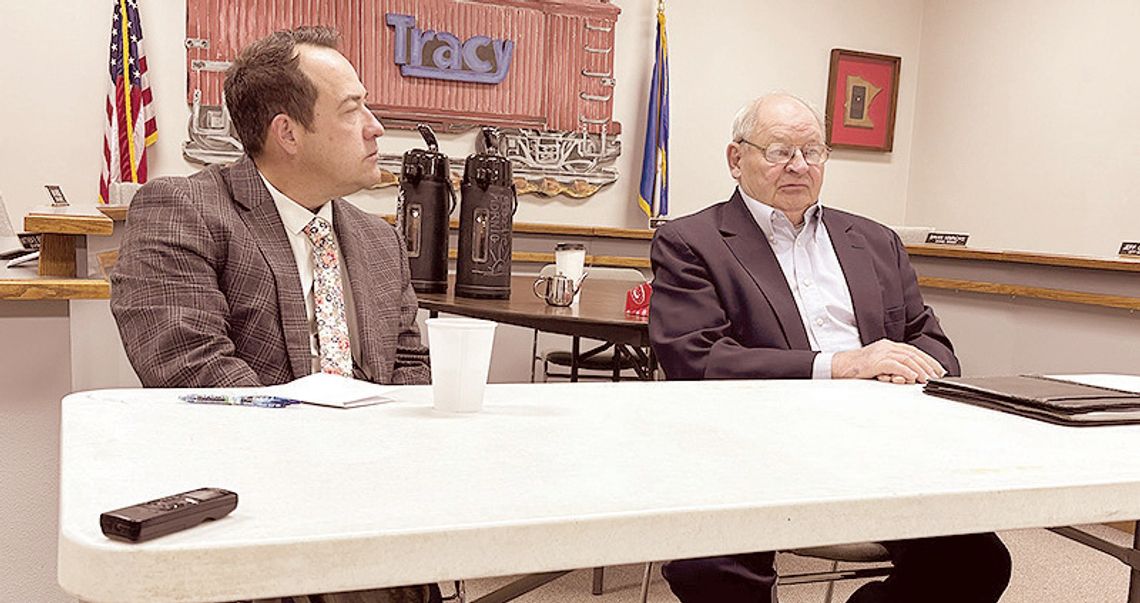
District 15 towh hall meeting with House Rep. Chris Swedzinski and Sen. Gary Dahms
Is the new state-mandated Paid Family and Medical Leave a blessing or a curse? The answer to that question depends on who you ask.
If you’re an employee who earned a minimum of $3,900 last year, it’s certainly a blessing, since as of Jan. 1, 2026, you get up to 12 weeks paid medical leave — with a maximum of 20 combined weeks per year — for yourself or to care for a family member.
If you’re an employer, it’s a curse. And almost 12,000 people have already applied for the benefits of the newly-rolled out program, which provides partial wage replacement for bonding, serious health conditions, or caregiving, funded by employer/employee premiums.
“I think Minnesota will be known as the Cadillac as far as the benefits and what will ultimately be the cost,” said District 15A House Rep. Chris Swedzinski, who was in Tracy last Thursday along with District 15A State Sen. Gary Dahms for their pre-session tour of the region. “I think we’ve gone the furthest with allowing so few ‘outs.’” The program is administered by the Department of Employment and Economic Development and initially received an $800 million boost from the 2023 budget surplus, according to published reports.
The program will eventually be funded through payroll tax deductions of 0.88% of most salaries, with employers covering at least half that.
‘
You have no rights as a business owner to say, ‘I can’t participate, it doesn’t work for me.’
The governor wanted the biggest program to prove that it works. Well, we’ll see.
— D15A HOUSE REP. CHRIS SWEDZINKSI For small employers, the total is 0.66%, but employers could still be responsible for as much as 0.44%.
“The real sticky part of this is it also is a mandate,” said Swedzinksi (R-Ghent). “You have no rights as a business owner to say, ‘I can’t participate, it doesn’t work for me.’ The governor wanted the biggest program to prove that it works. Well, we’ll see.”
Dahms added that one of the biggest problems with the program is that it is run by the State; others, he said, might run a portion of it but will hire a service for the overall management.
“Here, the State of Minnesota is doing all the management of the program,” said Dahms (R-Redwood Falls). “They would not allow any outside services; we tried different ways to get that as part of the bill, but it just wasn’t going to happen. We have the strongest (program) of any state and the most costly of any state.”
Dahms warned that the loopholes within the program open the door for potential fraud, the new F-word in the State of Minnesota.
“We’re going to have a lot of people flying down to take care of mom and dad in Arizona in January, February and March,” he said.
Lyon County Sheriff Eric Wallen made a push for the legislators to devise a plan this session that would create exemptions for the public safety field.
“What’s going to happen when Tracy has two of its officers go on 12 weeks or more of leave? Who’s going to police this town?” Wallen asked. “Or our office — if I had 25% of my jail staff go on leave — and nothing prevents that — I’m going to have to shut the jail down and we’ll have to house our inmates in another county at more costs to our taxpayers.”
Wallen said the Sheriff’s Office can’t hire and train someone inside the 12week timeframe an employee might be gone from work.
Swedzinski agreed that the new system has potential to create some real problems for departments with a limited number of employees. And that goes for government agencies as well.
“You could have the economy essentially shut down the week before and the week after Labor Day, the week before and week after the Fourth of July, the week before and the week after Memorial Day because people are sick or have someone to take care of,” he said.
Issues are more likely to arise, Dahms said, if you couple the Paid Family and Medical Leave program with Earned Sick and Safe Time, which requires most employers to provide paid time off for employees’ or family members’ illness or medical care.
“If one don’t bite you, the other one will,” said Dahms. “In the past couple of years, we have tried very hard to get somebody to come with us in order to make some changes. In one of the committees we did get a slight exemption in a committee, and we got some DFL votes to do that. That bill was voted down (34-33). But we’ll keep working on it.”