Go to main contentsGo to main menu
Thursday, March 26, 2026 at 11:38 AM

The healing never stops

The healing never stops
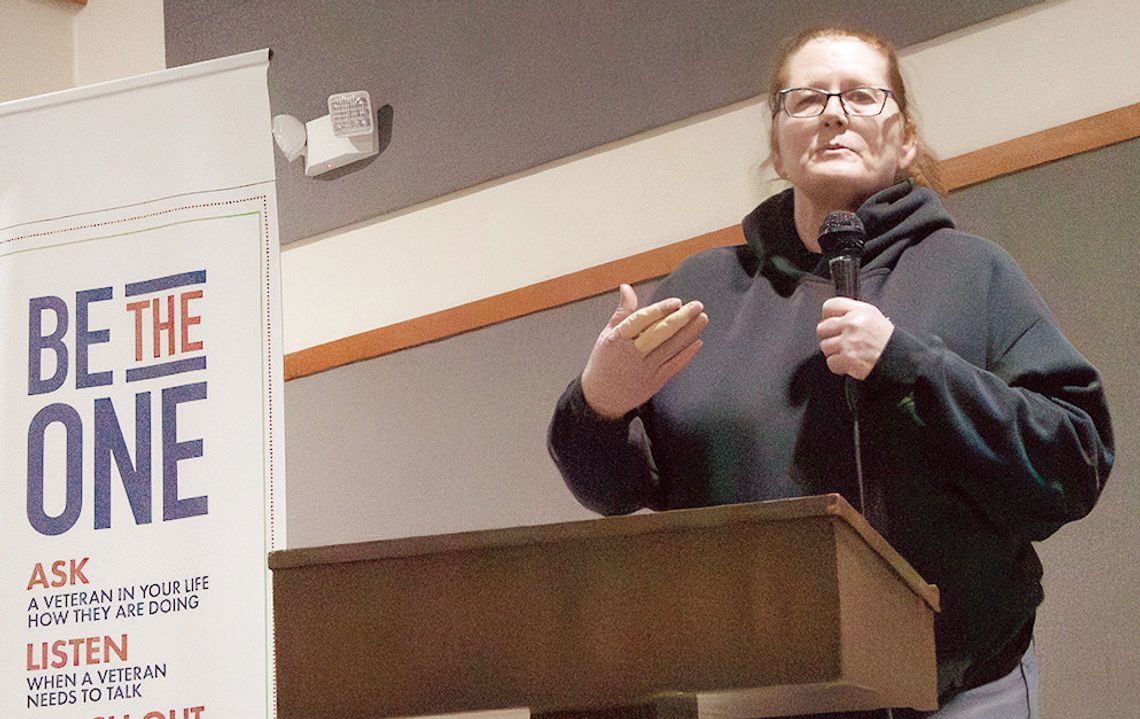
FULDA RESIDENT SHERI JOHNSON spoke at Monday’s “Be the One” community veteran suicide prevention awareness event in Slayton about her military son, Trever, who suffered from Post Traumatic Stress Disorder and took his own life in 2012. Photo / Per Peterson

Mother of suicide victim shares her story at ‘Be the One’ veteran suicide prevention event

Among the numerous presenters at Monday night’s “Be the One” suicide prevention conference in Slayton, one stood out and left a lasting impression.

That was Fulda resident Sheri Johnson, whose son, Trever Gould, took his own life in June 2012, after serving in Iraq for the U.S. Army.

“He decided that he wasn’t going to fight with the demons anymore,” Sheri said as she opened her 14-minute speech.

Trever joined the military in 2006 and was shipped to Iraq in 2007, serving two years in Mosul — “not a lovely place,” Sheri said. He was home in time for Christmas in 2009.

Sheri admits she knew little about Post Traumatic Stress Disorder, so she didn’t know what to look for during her interactions with her son.

“It was after the fact that it was like, ‘Oh my gosh, that was a sign,’” she said. “You look for a change in attitude, a change in anything. You watch your watch your child grow up, you know what they’re like, and you always think, ‘He’s not going to do that, he’s too strong.’” But that wasn’t true for Sheri and Trever. Trever was stationed at Fort Hood in Texas when a shooting resulted in the death of four Fort Hood soldiers, as well as the gunman. That incident, Sheri said, also fed into the survivor’s guilt that was already brewing within her son.

Trever attended college in Mankato and had a deep interested in diesel mechanics and cars. Sheri did notice during summer break that he seemed moody, but didn’t think much of it at the time.

“No matter what we think, we’ve all been in some situation where we think life isn’t that great,” Sheri said. “We need to reach out because life can be pretty good. But he didn’t think it was; he was having problems with his girlfriend — I can only image what she was going through with his attitude.”

What would end up transpiring was something the family had sadly been through before, as Trever’s stepfather was a victim of suicide as well.

“I thought I knew what Trever felt about suicide,” Sheri said. “I didn’t pay attention, I didn’t know signs.”

Trever found a summer job to make money for school, but he still carried fears about losing his girlfriend. One morning, Sheri noticed his lunch bucket was still in the house, but thought he might’ve gone out to eat with his friends. She saw his car outside, too. Again, she downplayed it, assuming someone had picked him up to go to work.

However, she also had that “gut feeling” that something was wrong. Fearing the worst, Sheri climbed the staircase up to his room on her hands and knees, thinking she would find her son.

He wasn’t there — a good sign, Sheri thought. Then she went outside to hang clothes on the line and noticed the garage door was closed — it was partially open the night before. Something wasn’t right, she remembers.

“I went into the garage and found him; he hung himself,” Sheri said. “There’s nothing worse in the world than finding your son hanging there. I’m freaking out, I’m screaming.”

Sheri ran into the house to call 911 but quickly realized she needed to rush back out to check Trever for a pulse.

He was cold. Sheri closed his eyes. “I gave him life and seen him open his eyes for the first time — I’ll thought, ‘I’ll close them,’” Sheri said.

The 911 dispatcher was a family friend, and living in a small town, the police knew the family as well.

“They watched my son grow up,” Sheri said. “They have to go through this, too. His death reached so many people, changed so many people. And not always in a good way. I’m not the same person I was back then.”

Suicide deaths among veterans, Sheri said, reached its peak in 2012 — the year Trever took his own life.

Part of Sheri’s personal transformation was her attitude toward suicide. That’s why she partnered with one of Trever’s brothers in arms in Iraq to start a non-profit called the Trever Gould Soldiers Help Project. They held a suicide prevention walk just two days after Trever’s death.

“It’s been a great thing for healing for me,” Sheri said. “When we save somebody’s life through the organization … my son saved somebody’s life, it ain’t me.”

The organization is targeted at veterans who are transitioning into civilian life. Sheri said her original Facebook page was stolen by a hacker in 2024, so she had to start all over again to get Trever’s site back online.

“Look for the one with my son and his dog … and our emblem,” Sheri said. “I’m here for anybody, just to talk. It stays with me, because I know we have a problem with vets thinking that if they open their mouth, it’s going to go on their record — it’s going to say, ‘I have a mental issue.’ It’s hard to convince a veteran to talk.”

Sheri said she works with similar organizations that are there to help with issues like suicide, and alcohol and drug abuse.

“I love doing what I do,” she said. “I’ve met a lot of wonderful people, and people care. I’m here to tell you, there’s nothing in this world that is so bad that you have to make that choice. Talking and listening works!”

Other speakers Monday included Machelle Kocer, community engagement partnership coordinator with the U.S. Department of Veterans Affairs; Slayton American Legion Commander and organizer of the event, Brad Pagel; and Chase Arden, veterans community health coordinator with the Minnesota Department of Veterans Affairs.


Share
Rate

Tracy Area Headlight Herald
Borth Memorials
Murrayland Agency