Memoirs of a Tracy Kid
FContinuing from last month’s column, we left Amsterdam on a train to Koln, Germany. Once we arrived, it was still early in the afternoon so we decided to continue on to Koblenz, Germany.
Once we arrived in Koblenz, we found the tourist office outside the train station which was our normal practice in Europe whenever arriving at a new destination. There we discovered that hotel rooms were quite expensive, way too much for our budget. We decided to try the local campground across the Rhine River and took a bus and ferry to it. However, once we arrived, we found that they wouldn’t let us camp there without a tent.
Our last option was the local youth hostel located in an old castle on the side of the mountain above Koblenz. There was a chairlift to the castle but it wasn’t operating so we had to hike up to the castle with our fully loaded backpacks -- ugh.
When we finally made it to the youth hostel, we found that you couldn’t leave in the morning before 7 a.m. and we had to catch a boat at 7:30 a.m. Now what?
It was getting dark so we decided to camp in a vacant field behind the castle where a few other young people elected to do the same. Since we didn’t have a tent, we just rolled out our sleeping bags and slept under the stars.
We finally fell asleep around 11 p.m. and were awakened at 1:30 a.m. by rain, lightning and thunder – the whole works! We rolled up the sleeping bags and ran back to the castle which had some tunnels underneath it on the back side. There we escaped a subsequent downpour and along with two other guys ended up spending the rest of the night sleeping in our sleeping bags on a cobble stone floor in one of the tunnels. But hey, the price was right, it was dry and we didn’t see any rats the rest of the night (operative word is “see”)! We did not sleep much on those cobble stones.
The next morning, we got up early, made our way back down the mountain and took the ferry back to Koblenz where we caught an old steamship which traveled down the Rhine to Bingham.
The journey was at a leisurely pace and the boat featured an open deck, allowing all the passengers a view of the many castles in the hills on both sides of the river. We arrived late that afternoon in Bingham where we spent the night. The next morning, we caught the train to Augsburg on our way to Munich.
After a night in Augsburg, we finally arrived by train in Munich and found the cheapest room we could at $7 which was still over our budget.
Then we visited St. Peter’s church, a large old gothic church in central Munich. It contained a jeweled skeleton of some martyr which made for an interesting photograph. We also tried to take a tour of the Lowenbrau brewery but it was booked up.
The following day we got up early to catch the 9 a.m. Lowenbrau tour which we found to be very interesting. At the end of the tour, our empty stomachs were treated to a liter of beer and sausage sandwiches which was a great free lunch. While enjoying our lunch at the brewery, we struck up a conversation with another American couple our age who were camping in Munich.
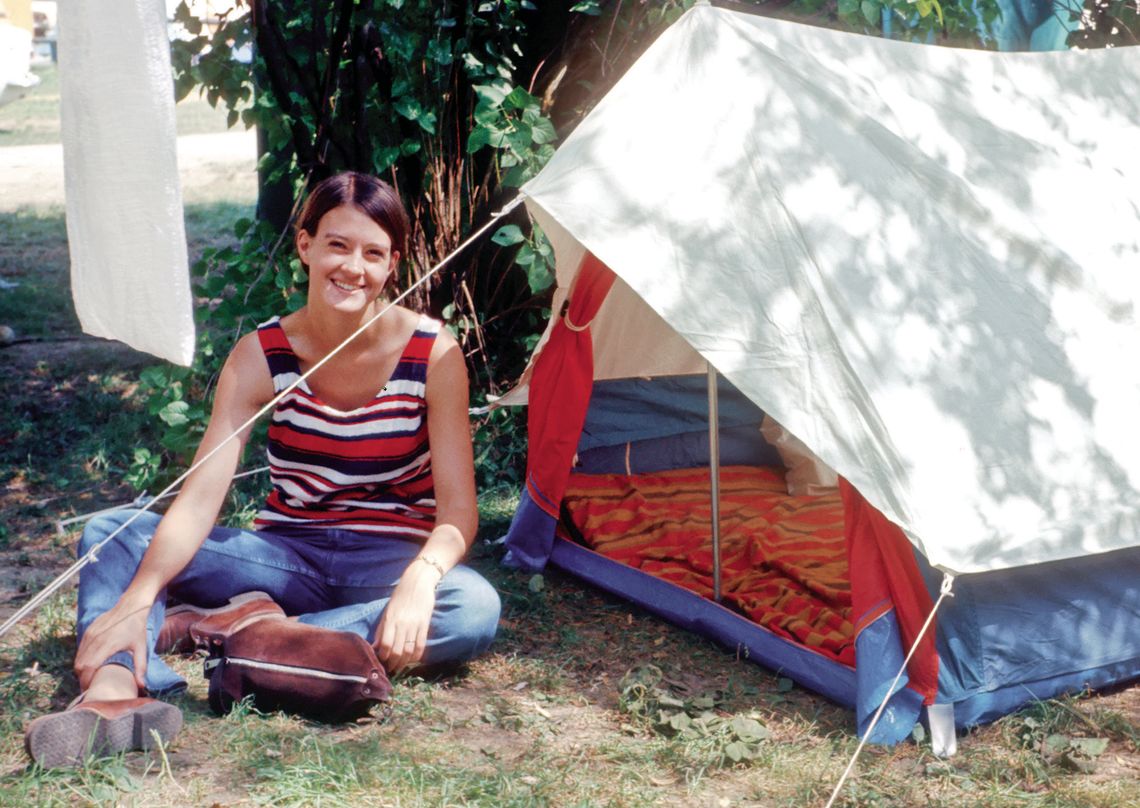
We had been thinking of buying a tent because of the high cost of hotels in northern Europe. This couple told us how easy it was to find campgrounds near train stations so we thought maybe we should give it a try. After waiting awhile to sobber up, we headed to a nearby department store and found a small two person “pup tent” for the equivalent of $22. The next day we checked out of our hotel and found a public campground near the Munich train station where we set up our new tent.
From then on, other than in Spain where hotel rooms were very cheap, we camped for the duration of our trip through Europe. That tent was tiny, but we squeezed ourselves and our backpacks in every night. We didn’t have any sleeping bag pads so I carefully cleared the space under the tent of all rocks, sticks, etc. before erecting the tent at each campground. The ventilation also was lacking, but the campgrounds had showers and the price was right.
We spent several more days in Munich including a day train trip to Fusion to see King Ludwig’s Neuschwanstein Castle. This is a fairy tale like castle in white stone with a draw bridge on a mountain top. It is the one that Disneyland used as a model for the Cinderella castle.
Another highlight of our stay in Munich was an evening at the Hofbräuhaus beer hall. If you’re a beer lover, this was the Super Bowl of party houses where the standard sized beer mugs were one liter, and they got even bigger if you were really thirsty. The big bosomed waitresses wore traditional German lederhosen and carried 5 full to the brim beer mugs in each hand as they served their patrons, all sitting around long tables. At one end of the hall, the beer stored in large 60-gallon wooden kegs was brought up from the basement on an elevator one barrel at a time. The ambiance was enhanced by a polka band at the other end of the hall. I don’t think there was a sobber person there. Fortunately for Bobbie and I, we were walking and didn’t have to drive back to the camp ground late that night.
After Munich we took the train to Salzburg, Austria and found a campground on the Danube River which only charged 50 cents a night, including hot showers – the main reason we switched to camping. While in Salzburg we took a tram up to the Hohe Salzburg Fortress, which was quite impressive. We only spent one day at Salzburg before heading to Vienna. The train to Vienna was one of the nicest we had been on thus far on our trip. While in Vienna we visited the Stadt Park where we found an orchestra playing the Blue Danube Waltz at an outdoor band shell (it was true Vienna!) and also visited the Schoenbrun Palace which had large gardens but they didn’t quite rival the Versailles palace in Paris.
Next on our agenda was Italy which began our journey along the Mediterranean. We took the train from Vienna to Venice where the train station was at the end of the line on the island of Venice. Right outside the train station was the tourist office where we learned of a nice camp ground on the island of Ledo, just off of Venice. We took a water taxi to Ledo and set up our tent along the shore of the Aegean Sea. It was the nicest campsite of our entire trip.
Venice was a magical place with no cars. You either walked or took a boat on the canals to get everywhere (we walked). We spent a day there wandering around the many canals and visited St. Mark’s Basilica, marveling at the big square in front of the church all made of white marble. We also enjoyed swimming in the Adriatic Sea after taking the water taxi back to our campground after a day of sightseeing. And according to our diary, we headed back to Venice that evening for dinner and to see Venice at night.
Last summer we had the chance of again spending two days in Venice at the end of a hiking trip to the Swiss Alps that started in the Italian Dolomites and ended in Venice. While little had changed architecturally in the ensuing 54 years since we first visited Venice, the number of tourists we encountered was overwhelming! Venice today reminds me of visiting Disneyland on a holiday weekend. We stayed in a hotel on the island and first thing in the morning when the trains and busses arrived, it was like the flood gates opened and the crowds of people stayed until late into the night. We experienced this same phenomenon on several other trips we took during the past five years to Italy, France and Spain. It seems as though everybody around the world is now traveling to Europe during the summer and tourism is now the primary business in most large European cities. We were so fortunate to experience uncrowded Europe 55 years ago.
Next month: More on Italy & Spain.