A new, high-tech piece of equipment at Sanford Tracy should not be measured by its size, but what it can do to help patients
It’s the size of a remote control, but what it does is just a bit more important than skipping from Netflix to Hulu on your television set.
It’s called a Butterfly transducer — known in leyman’s terms simply as a wand.
And it’s a lifesaver, says Elishia Christians, a family medicine nurse practitioner at Sanford Tracy.
“There is just so much that we can do with this ultrasound device!” Christians said.
Sanford Tracy was invited to join the Point-Of-Care Ultrasound (POCUS) project through High Quality Medical Education (HQMEDED) a few years ago, Christians said.
HQMEDED consists of faculty and friends of the Department of Emergency Medicine at a Level 1 Adult and Pediatric Trauma Center in Minneapolis, with the goal of providing education to healthcare providers to better patient outcomes and save lives.
It allows us to not mess around — we can bypass CT, call Sioux Falls faster.
Within minutes, we can identify something.
— ELISHIA CHRISTIANS, FAMILY MEDICINE NURSE PRACTITIONER AT SANFORD TRACY “One of the projects they have been working on over the last few years is the POCUS project,” said Christians. “Through a generous grant from The Leona M. and Harry B. Helmsley Charitable Trust, the POCUS project has provided the opportunity for rural healthcare providers to learn how to use ultrasound technology at bedside.”
Christians said Sanford Tracy is blessed to be part of the multi-million-dollar medical education project . The initiative trains providers to perform and interpret bedside ultrasound scans to make rapid, accurate diagnostic decisions. This allows providers in an emergency situation to identify life threatening conditions and decreased transfer time to a facility where the patient can have a higher level of care.
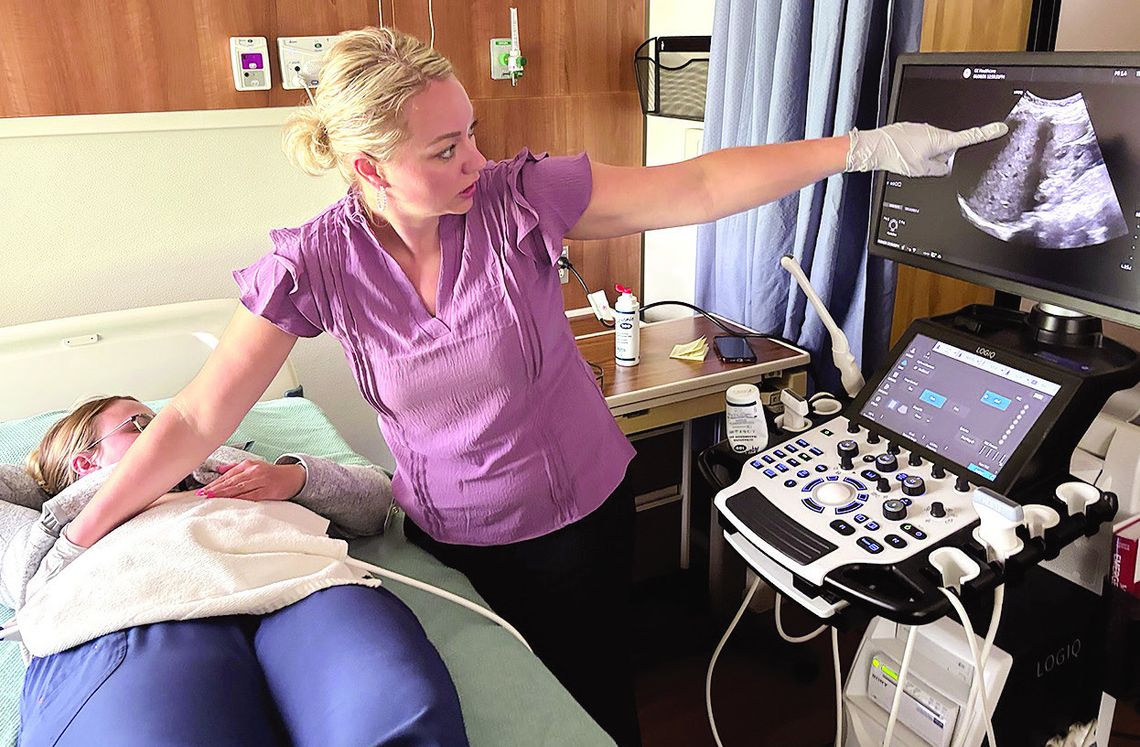
“Our primary focus of learning at Sanford Tracy was the FAST exam (Focused Assessment With Sonography for Trauma),” Christians said. “The FAST exam is a lifesaving assessment that can be used in emergent trauma situations at bedside in the Emergency Department.”
For a FAST exam in the emergency department, the provider assesses for free fluid (blood) or air in the abdomen, chest cavity, heart, and lungs. Specific attention is paid to the liver, kidneys, spleen, lungs, sac that surrounds the heart, and the pelvis. This can be done in less than five minutes and can identify life-threatening bleeding, pericardial effusion & tamponade (abnormal heart beat), and/or pneumothorax (collapsed lung) early so life-saving interventions can occur and transfer plans can be made to a facility that is higher level of care.
“This exam also allows for more information for the receiving facility if the patient is transferred, allowing them to be ready with interventions instead of starting a work up there,” said Christians. “It speeds up care.”
The POCUS project provided Sanford with Butterfly Ultrasound Transducers (a wand) and the application that goes with the device, Christians said.
Providers from HQMEDED came to Sanford multiple times a year over the course of the last few years to train providers in the FAST examination and nurses in IV placement and bladder scanning. The project also included conferences throughout Minnesota that providers could join to continue to gain knowledge and practice ultrasound skills. Many providers at Sanford Tracy and Westbrook joined the conference in Redwood Falls this past fall.
The transducer, which can also produce images on one’s smartphone, is a lifesaver because it’s a time-saver, Christians said. It allows practitioners to identify life threats much quicker than a CT scan would.
“From a trauma perspective, if you were hit in the abdomen or have a collapsed lung, we can find that quicker with this ultrasound. It allows us to not mess around — we can bypass CT, call Sioux Falls faster,” she said. “Within minutes, we can identify something.”
The Butterfly wands cost between $2,500-$4,000. Sanford Tracy also has a GE Ultrasound Machine, which the providers are now also able to use for the FAST exam.