Go to main contentsGo to main menu
Thursday, July 9, 2026 at 12:56 PM

Catching up with …

Catching up with …
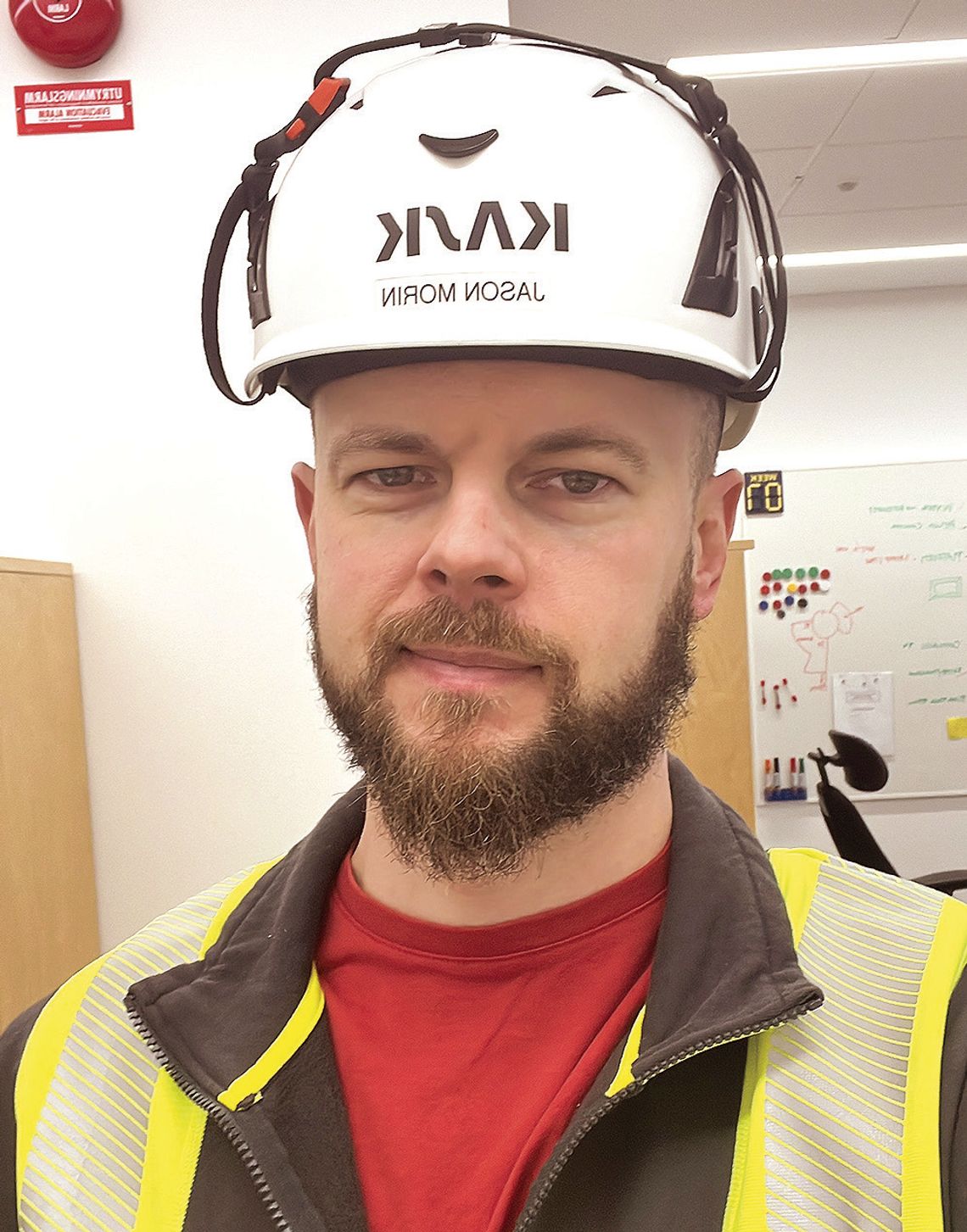
JASON MORIN, a 2004 TAHS graduate, is living in Sweden wherehe works at a large-scale research facility. Submitted photo

Jason Morin, THS class of 2004

Holding the keys to success

Jason Morin traveled a long way to make an impact as an engineer

JASON MORIN, A 2004 TRACY AREA HIGH SCHOOL GRADUATE, HAS MADE IT A LOT FARTHER IN LIFE THAN MANY DO.

Literally, farther. Morin moved to Lund, Sweden, in early 2025 to take a job at a research facility called the European Spallation Source (ESS).

ESS is a large-scale research facility that uses neutrons to study the properties of matter. Elementary particles — the building blocks that make up things like protons and neutrons — are so incredibly small that scientists have to use complicated instruments in order to measure the particles and their movements. Because neutrons have many special qualities, such as their ability to penetrate deep into matter, scientists at ESS use them to measure the exact location of atoms and how they move.

“Catching Up With …” is a periodic feature of the Tracy Area Headlight Herald and is designed to highlight the exploits of Tracy Area High School graduates. If you have a suggestion of someone you think should be included in this feature, email the editor at [email protected]

Morin is an Instruction Operations Engineer at ESS. According to him, his job is not to “do science,” but to “hold the keys” to one of the scientific instruments in the facility. He ensures that everything is working correctly before the scientists begin their work.

The particular instrument Morin works with is named the Test Beam Line (or TBL).

“While other instruments are highly specialized for a specific type of measurement or a specific type of science, the Test Beam Line is a jack of all trades instrument,” says Morin.

The Test Beam Line generates a powerful beam of neutrons that can be used to measure atomic movements. When the beam is directed at a material, the neutrons scatter. Scientists measure the way the neutrons scatter as a way to gain more information on the specific material they are studying. Simulations are done ahead of time to give the scientists a prediction of the number of neutrons and what types of energies they will have, but the science isn’t certain until the measurements can be made by the machine. Morin’s job is to make sure that the machine is working as intended. Once the machine is working, it can be used to test other detectors or any materials the scientists wish to study.

Morin started at ESS in May 2025. Before then, he’d worked in the Army National Guard and Army Reserve for 22 years, starting shortly after his graduation from TAHS. During that time, he also studied at the University of Maryland and earned his Master’s Degree in Mechanical Engineering in 2009.

“My goals nearing graduation (from TAHS) were not so different from other kids my age,” he said. “I wanted to get out of Tracy, and to run track in college.”

He did manage to get out of Tracy, but he hadn’t quite imagined exactly how far away he’d end up.

In high school, he’d made himself very busy with extracurricular activities. For all six years of school, he played football and competed in track and field. He was very successful in track, qualifying for state twice in the pole vault; he actually did end up running track in college for a year. Other activities he participated in during his high school career included wrestling, band — where he played alto saxophone — and FFA. In his senior year, he also competed with the state-qualifying Knowledge Bowl team. Outside of school, he competed in tae kwon do at the state level.

After graduation, he added a new goal: to serve in the military. He started by joining the Army National Guard unit in Marshall. In his 20-plus years of service, he served from coast to coast in the States and also travelled to three different countries. He retired from the military in the beginning of 2025.

After retiring from the Army National Guard, Morin discovered some newfound freedom. With this new freedom, he and his wife decided to try living abroad, which was something they had talked about doing for years.

“You generally can’t just move to Europe because you want to,” Morin said. “Most people move because they get a new job in a new county.”

Morin applied to a few different European research facilities — to which he had some specialized experience from working at Fermilab, a laboratory near Chicago — and after interviewing, was hired by ESS. Shortly after, he and his wife relocated to Lund and he began his new work.

The Lund area is in southern Sweden, which is primarily farm country, and with farms come many windmills. Morin often jokes that they moved quite a long way just to live in a place that looks a lot like Pipestone — his wife’s hometown.

Along with this similarity, Morin has also found some key differences between Minnesota and Sweden.

“Winter here is not as bad as I was expecting,” he said. “It was not nearly as cold as Minnesota, but just as windy. It was pretty wet and gloomy, but having lived in Seattle for six years I was prepared for that, too.”

He also describes their nottoo- hot summers that come with fewer mosquitoes than ours.

Another thing Morin misses from the States, other than being closer to family and friends, is being able to find certain foods.

“Good avocados are almost impossible to come by,” he said. “Certain foods like Wheat Thins, molasses, clam juice, and good corn on the cob, you simply can’t find.”

He often has to substitute in new ingredients for his recipes. Others, he can’t make at all.

Overall, Morin really doesn’t miss living in the United States too much.

The teacher who had the most impact on him in high school was English teacher and coach Steve Jones.

“He really cared for us not only as students and athletes, but also as people,” said Morin. “He definitely knew how to push us to reach our true potential.”


Share
Rate