Cell phone policy remains a hot topic as TAPS school board welcomes new members
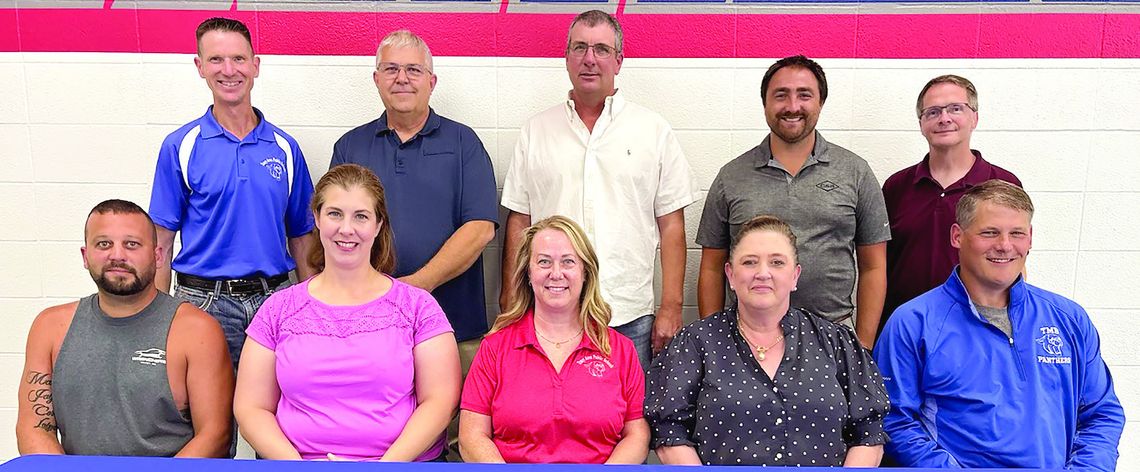
A new era began last Thursday when three members of the now-defunct Milroy School Board joined current Tracy Area Public Schools board members for the first-ever District No. 2913 School Board meeting.
The three members who have come over from Milroy are Ashley Christensen, Scot Bowman and Adam Snyder, and while the board took on a different look, the topic that got the most play Thursday is nothing new.
With another school year approaching, the school district’s cell phone policy owned the spotlight. Tracy Area High School Principal Mandy Dibble addressed the board, first outlining a number of revisions to the student handbook before diving into the district’s cell phone policy.
Dibble met with the board’s policy committee last Monday, discussing how the district can build off the current policy. She told the board that the committee came up with four options to address the ongoing issue — the first being to not use the new, lockable Yondr pouches that in May were purchased by the district, and to implement more strict consequences for offenses, including expulsion for a fifth violation.
“This is similar to what we currently have in our handbook, but changing the consequences,” said Dibble.
This option includes a lunch exception.
Another option is a hybrid model with the pouches to be used by students in grades 7-9, but not by students in grades 10-12 (this also carries a lunch exception). Students in grades 10-12 would be required to keep phones in their lockers. A first violation would require the student to pouch their phone for 20 school days; a second violation would mean pouching for 30 days and comes with detention and a book report; a third violation adds a second book report to that; and a fourth violation would pouch the phone for the remainder of the school year, and lead to detention for three days and three mandated book reports.
Option C would implement pouches for all students with a lunch exemption; and Option D would be to pouch phones for the entire school day, including over the lunch period.
“When we talk about pouching phones — and this would be for any (student) — it’s while they’re in the building,” Dibble said. “Anytime on any of these (options), if a student leaves for an appointment, if they leave early for sports, they go home for one period for PSEO classes, they would unpouch their phone.”
Dibble also recommended that students can unpouch their phone if they leave the building for open lunch. Another exception would be for students who have a documented health issue, such as diabetes.
In 2022, the district’s cell phone policy stated that students must keep their phones in their lockers at all times; however, it was thought by some that the policy lacked teeth in terms of discipline. Color-coded zones were put in place the following year, and classrooms at that time had a phone caddy where devices were to be put during class.
The cell phone policy in 2024 was similar to what the district implemented this past school year, where students needed to keep their phones in their lockers during the whole school day, including lunch. The current cell phone policy states that cell phone use is not allowed between 8:02 a.m.-3 p.m. and that students’ phones are to be stored in their lockers during that time.
“The only thing that changed from 2024 to 2025 were the consequences,” Dibble said. “We had students this past year who would get their fourth and fifth offense, and they turned their phone in to the office for quite a long time.”
The main reason Dibble was asking for another policy change is because she and her staff believe the Yondr pouches will make a significant difference — 80% of teachers were on board with Yondr pouches last year; since then, Dibble said, the pouches have a 95% approval rating among staff.
She noted that there are several schools in the area that are using them with success. She, herself, used them while she was a teacher at Westbrook-Walnut Grove. She added that since she’s been at TAHS, the vast majority of students do not keep their phone in their lockers.
“It’s hard to have a policy that’s difficult to check and enforce,” Dibble said. “I would guess 90% of our students are not leaving them in their lockers all day.”
Board member Jeff Knott, who is on the policy committee — which also included parents and students, along with district staff members — introduced a number of statistics to the board, calling the use of cell phones one of the more pivotal topics that most school boards face today.
Knott said the current cell phone policy lacks disciplinary actions and penalties that would potentially discourage their use during class time.
“If all we have to do is turn our phone in to the office — doesn’t really matter, doesn’t hurt,” said Knott. “We took a lot of time to put in some deterrence in the policy. We all really want a cellphonefree classroom and learning environment, but the way that we get there is very different; we have very polarized views on how we achieve that.”
A three-question survey that was sent out to parents this year showed that 54% believe the current policy is effective, and 49% were “likely” not or “absolutely” not open to adopting the use of pouches, while 44% were “possibly” yes or “definitely” yes and 7% were undecided.
According to district data, 59% of students had zero cell phone offenses during the 2024-25 school year, and last year that number rose to 63.3%. Total infractions during that time dropped to 206, down from 253 the previous year. Also, in 2024-25, 66 students had at least two infractions, and 32 had three. Last year, 54 had two infractions and 26 had three.
Knott said it is important that parents, the board and committee are doing their due diligence and offering a variety of options. He added that the board has a responsibility to make data-driven decisions based on objective, evidencebased findings, rather than rushing into a single commercial product because it is heavily marketed; and to be responsible with taxpayer dollars.
In other business …
• The board designated the Tracy Area Headlight Herald as the official newspaper and Minnwest Bank, Currie State Bank and Old National Bank official banks of District No. 2913.
• The lunch and breakfast fees for both public schools will remain the same as the last two years — $2.25 for a second entreé and $2.25 for a second breakfast; the district will continue to provide breakfast ($1.72) and lunch ($4.11) to St. Mary’s students with a second meal for $2.
• The FY2027 Truth-in-Taxation meeting will be held on Dec. 21, 2026, with a continuation meeting, if needed, on Dec. 22.
• The board approve the hiring of Blake Kruger as a JV football coach for the 2026 season; Amber Sundahl as TAHS student council advisor for the upcoming school year; and Melissa Wilhite as the head food service director and Jodan Sundahl as assistant food service director for the 2026-27 school year.
• A propane contract with CHS for 25,000 gallons for $1.59 per gallon, including a road tax of 20 cents, was approved with Chair Rod Benson abstaining.
• The board approved the following donations: $400 from Prairie View Healthcare for the Prairie View Scholarship; and $2,500 from the SW Arts Council for teen summer creative camps.
‘
If all we have to do is turn our phone in to the office — doesn’t really matter, doesn’t hurt. We all really want a cellphone-free classroom and learning environment … we have very polarized views on how we achieve that.
— DISTRICT NO. 2913 SCHOOL BOARD MEMBER JEFF KNOTT