WANTS & NEEDS
A variety of community members from all over the school district soaked up information last Wednesday about potential school projects
Business leaders, land owners, farmers, teachers, coaches, parents and grandparents — most graduates of Tracy Area High School — gathered in the high school cafeteria last Wednesday evening, but it wasn’t for a TMB Bowl, cheese sticks and fruit cups.
Instead, those attending the Tracy Area Public Schools Task Force Meeting were hungry for information about potential largescale projects that would change the face of the schools.
The district has $4.6 million burning a hole in its collective pocket, funds left over from the two-year infrastructure project thanks to lower-than-anticipated bids that came in for the project; bond interest earned over a full two years; and frugal spending.
Tracy Area Public Schools Supt. Chad Anderson said since project spending was approved by the voters of the district, they will have a say in how that money should be spent.
“That’s what we’re all here for, to talk about all of these ideas,” Anderson said.
Representatives from ISG Engineering, Ehlers and Morton Construction Managers spelled out — in as much detail that is appropriate at this time — various pieces that could go into the construction puzzle.
Everything discussed last week were only ideas, as nothing has been close to being decided on yet. Any decision would come after a community survey is vetted. People who live within the 440-square mile school district can expect to receive the survey that will be used to collect input from residents on any potential project(s) on or before Sept. 28.
Bryce Sievers, architectural designer for ISG, outlined the different project scopes in the two buildings last Wednesday.
“Our job at ISG is to take those ideas, and see how can we start seeing the feasibility of them,” Sievers said.
Ideas talked about last week included improvements/additions to both schools:
‘
… everyone has built new or added onto their building. We have protected our assets, we’ve put a lot of time and effort into making sure our facilities are beautiful.
— TAPS SUPT. CHAD ANDERSON • Tracy Area Elementary School — Secure entry/ administration addition ($677,250 estimated cost); build a Special Education (SPED) wing ($502,000); a classroom addition ($308,625); add a new 5,495-square foot cafeteria/cafetorium and kitchen renovation ($3,029,000 with a stage; $2,346,600 without a stage); or build a new 5,500-square foot gym ($2,337,500).
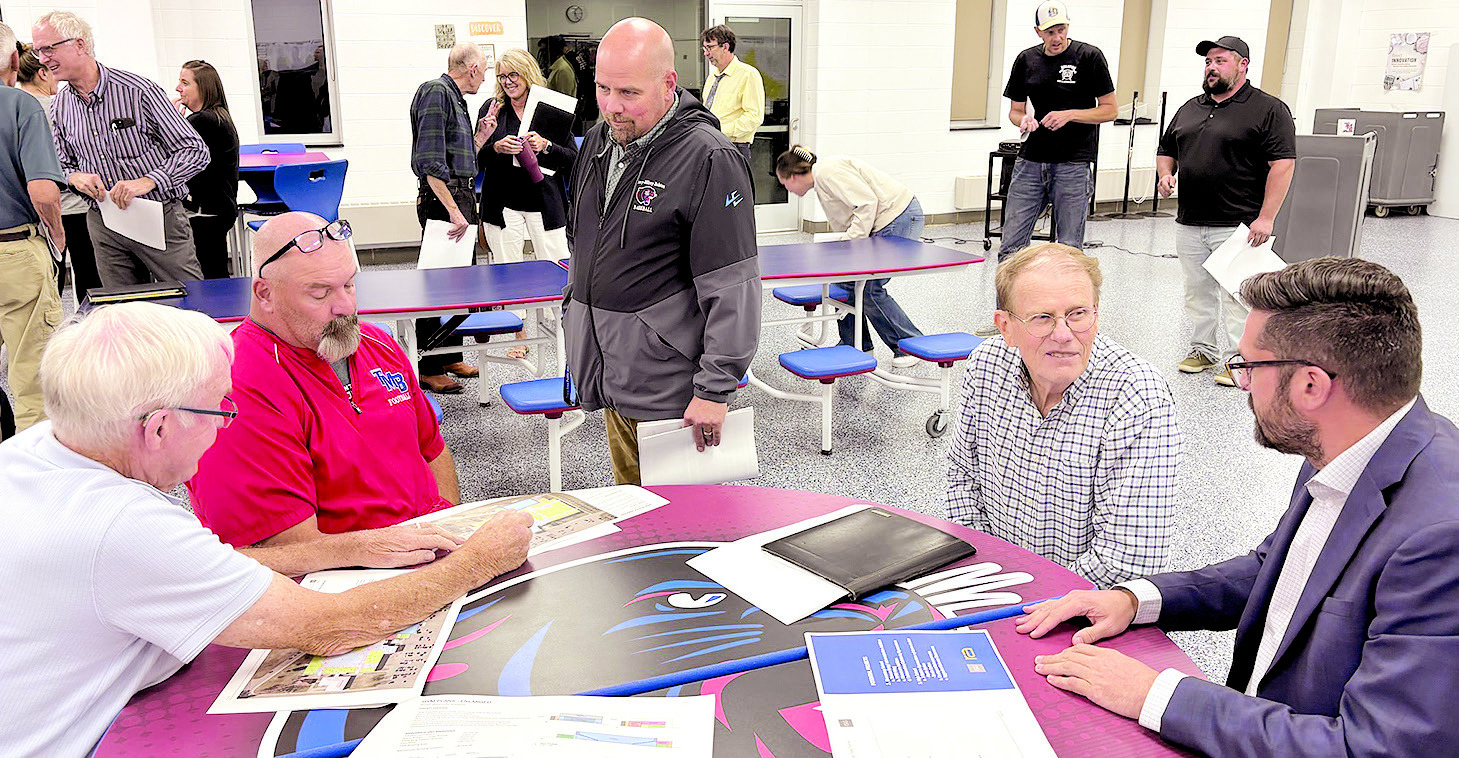
DENNIS FULTZ, JASON KAINZ, BILL TAUER, Seth Schmidt and Burke Gardner talked about potential future projects the school district is considering after last week’s TAHS Community Task Force Meeting. Photo / Per Peterson
• Tracy Area High School — Build a three-stage gymnasium with a storm shelter on either the north or south side of the building that would create a centralized location for practices and games; transform the current and seldom-used outdoor courtyard into a legacy room/ gathering space ($5,514,723); or upgrade science classrooms ($636,061).
The rough cost of a new gym on the north side of the high school would be $20,731,316; the cost goes up a bit to $20,825,066 if the south option is preferred. Anderson said a new gym at the high school would complement the VMC, which is used almost on a daily basis by the school.
Anderson, who spent some time Wednesday discussing the great shape both the nearly 60-year-old school buildings are in, insisted the school district is not in a “keeping up with the Joneses” mode. However, he also noted that most every school surrounding Tracy has either built new schools in the last few years, or have recently made significant additions to their campuses.
“The only two schools that haven’t are Tracy and Westbrook-Walnut Grove,” Anderson said. “Other than that, everyone has built new or added onto their building. We have protected our assets, we’ve put a lot of time and effort into making sure our facilities are beautiful.”
One question that arose from the meeting is how can adding onto the buildings be justified given the declining enrollment issue. Having so many school districts making improvements has created a competition for students of sorts.
“Unfortunately, it is a competition,” said Sue Peterson, education planning specialist with ISG. “With open enrollment, you are competing with other school districts for students. That’s not a scare tactic, it’s a fact.”
The question then becomes, is the school district focusing on addressing capacity and boosting enrollment, or is the goal addressing needs the district currently has?
TAHS Activities Director Bill Tauer said the answer is a little bit of both.
“We have needs, and if we’re going to do this, it would possibly draw students,” said Tauer. “That would be the goal.”
Anderson estimated that the district is down about 100 students over the last 15 years because of the changing landscape of rural Minnesota. He said the Luverne School District lost 100 students just last year.
“It’s not that people are going other places, it’s that you don’t have a farm family on every section, you don’t have families having four, five, six, seven kids anymore,” Anderson said. “It’s just a changing environment in rural America. I grew up in South Dakota — it’s been that way there for 50 years.”
He added that schools are the first thing families looking to put down roots look at, calling them the hub of every community, thus the need for keeping pace when it comes to technology and facilities, even though enrollment has been going in the wrong direction.
“I can’t tell the future, but I don’t see (enrollment) spiking up high, or dropping off low … we’ve gotten to the point where class sizes are around 45 to 55 for the next 20 years, just kind of hovering in that area,” said Anderson.
• An important part of last week’s discussion included tax implications on local landowners. Thanks to the school building bond ag credit, half of the projected costs of any project will be paid for by the State.
First enacted in 2017, the School Building Bond Agricultural credit applies to farmland excluding the house, garage and one acre, and managed forestland. The credit equaled 40% of the qualifying property’s net tax capacity multiplied by the school debt tax rate.
“The important piece here for the ag property owners is you’re not having to pick up the full cost of a levy,” said Matthew Hammer of Ehlers. “There’s a credit that automatically gets applied — you only pay 30% of the levy, and the State of Minnesota pays the balance. For us, 50% of the project then becomes state-funded.”
The 2019 Legislature modified the credit based on school building bond levies. The reimbursement percentages increased from 40% in taxes payable 2018 and 2019, to 50% for payable 2020, 55% for payable 2021, 60% for payable 2022, and 70% thereafter.
The estimated tax impact involves a 20-year repayment term. For a $23 million bond, the tax implication for a $215,000 residential home would be $126 per year, or $11 a month. For the same bond, the tax impact for a $10,000 ag homestead acre would be $1.10 per year, or $.08 a month. Those numbers would increase as the bond amount gets higher.
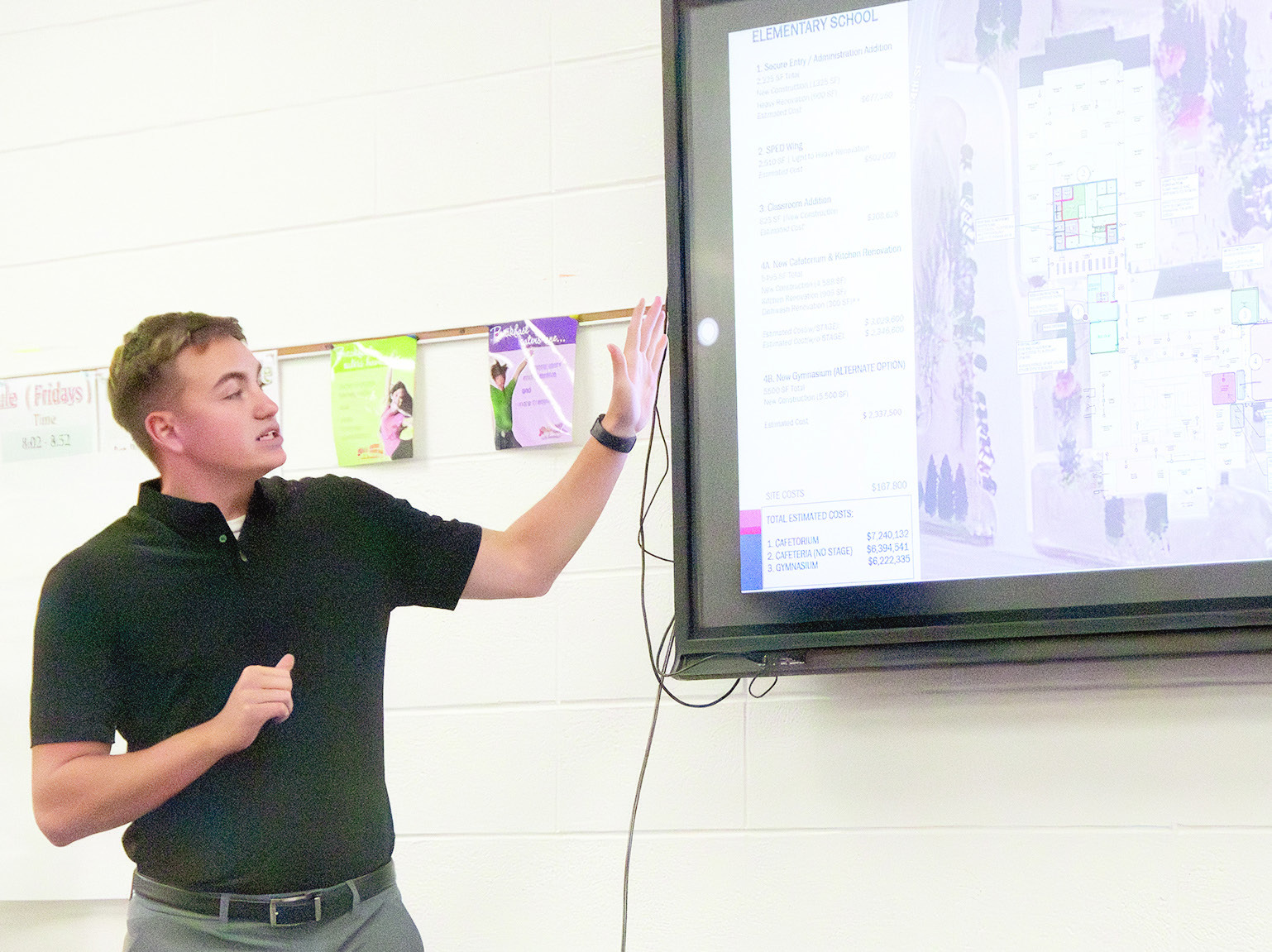
BRYCE SIEVERS OF ISG GOES THROUGH the details of potential additions to the Tracy Area Elementary School at the Tracy Area Public Schools Task Force meeting last week. Photo / Per Peterson