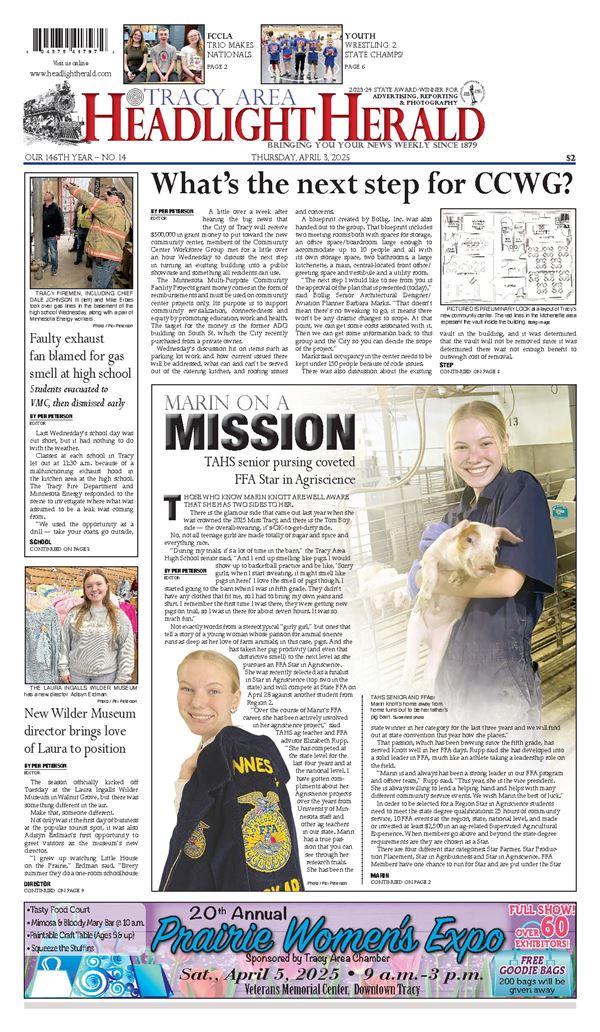
The front page of this week’s paper features a story about Tracy native and newspaper veteran Justin Lessman. He has been chosen as the next executive director of the Minnesota Newspaper Association and Minnesota News Media Institute.
In addition, I am writing my column this week from my hotel in Washington, DC. I have spent time at the 2026 Support Journalism Fly-in. I spent Tuesday on Capitol Hill in five different meetings discussing important legislation and challenges our industry is facing.
Yet, we battle the common phrase: Newspapers are dying.
This couldn’t be farther from the truth. Newspapers are not dying. We are vital to the future of the country. Is our industry changing? Absolutely. But it is so important that local journalism continues, and this week is an huge example of it.
Justin’s next career step shows his dedication to an industry he has spent his entire life in. He understands the many different aspects of the news industry.
I spent time with newspaper association directors from across the county as well as publishers, owners, CEOs, legal council and others from a wide variety of newspapers. In two of my meetings, I visited with Tami Hoffman of The Guardian, a UK-based paper that has expanded to a global publication with a large presence in New York. I also attended a meeting with Ray Rivera with USA Today and Christine Gartland with Hearst, a global company with work in newspapers, entertainment, magazines, real estate, health and more. To say I was the little fish in the big sea would be an understatement.
However, we were all there telling the same story. While we may be facing the challenges at a different level, we have many of the same challenges. We need our copy protected and our product delivered. Our website doesn’t have the same traffic as the USA Today or the Star Tribune, but we are still on the same web, facing the same bots scraping our content to distribute it for free on other platforms.
We also discussed postal frustrations, delivery issues and insanely rising costs. No matter the size of our business — a small publisher or a large company — we’re facing the same challenges.
But the big takeaway was the number of people there telling the story of local journalism. It was not rooms filled with all those at retirement age. It was full of people of all ages who care deeply about journalism and the future of local media.
This isn’t a large company challenge, it’s an industry challenge. Communities are better with local journalism. If you attend a local city council meeting, there room is very rarely packed with community members. People are busy, they have other things going on. But we are there. We are reporting on the decisions the council makes and how they spend your tax dollars.
We’re also at the school board meetings, the homecoming coronation, the community events, sporting events and tough meetings. That’s local journalism. It is the coverage and telling the stories of YOUR community. That is not going away.

Justin taking on the next challenge as well as the time I spent in Washington DC point to the future of local journalism. Whether you get your news from an e-edition or a printed copy, you are getting the news because of local journalists.
If you are reading the Tracy Area Headlight Herald, the Star Tribune or the New York Times, a journalist is covering those stories. Real people are putting that product together and getting it to the readers.
Since this country was founded, freedom of the press has been vital. Our forefathers knew how vital it was and put it in the First Amendment. Our country is 250 years old, which means local journalism in America is 250 years old.
We’re not dying. We are continuing to report and bring you the local news that matters to you. We’ve been doing it for 250 years and we expect to be doing it for 250 more.