Angela Kennecke continues to educate youth on the horrors of opiod abuse years after losing her daughter
There is a code among journalists that states they should never become part of the news. Reporters worth their salt are known for holding themselves to certain standards of objectivity and emotional separation while performing their professional duties.
These traits have always been practiced by Angela Kennecke, but this seasoned broadcast journalist was put to the test a little more than eight years ago.
Kennecke is an award-winning investigative broadcast journalist who some time ago became only the second woman to lead the evening news at KELO-TV.
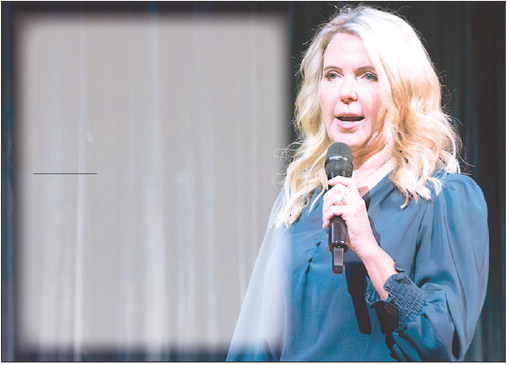
Through her bulldog reporting, Kennecke has uncovered fraud and corruption, resulting in changes to state laws, but it was 2018 when her professionalism was challenged unlike ever before.
That’s when Kennecke decided to give a special report on Keloland News on the opioid crisis. Keeping emotion out of her reporting was nothing new to her, but in this case, it was not only a professional challenge, it was a personal one because it came about a year after her daughter, Emily, died of fentanyl poisoning. Her work earned her two regional Emmy Awards in 2019.
“On May 16, my 21-yearold daughter, Emily, died of an overdose — her official cause of death was fentanyl poisoning,” Kennecke said to begin her report. “The loss of a child, especially in this sudden and shocking way, has turned my world upside down. I never intended to have a member of my family to become part of the statistics you hear on the evening news.”
Kennecke had decided to not run and hide from what happened to her daughter, but to embrace it to help others. Her only hope in the face of such a devastating loss, she said, was that her loss could be a template for change.
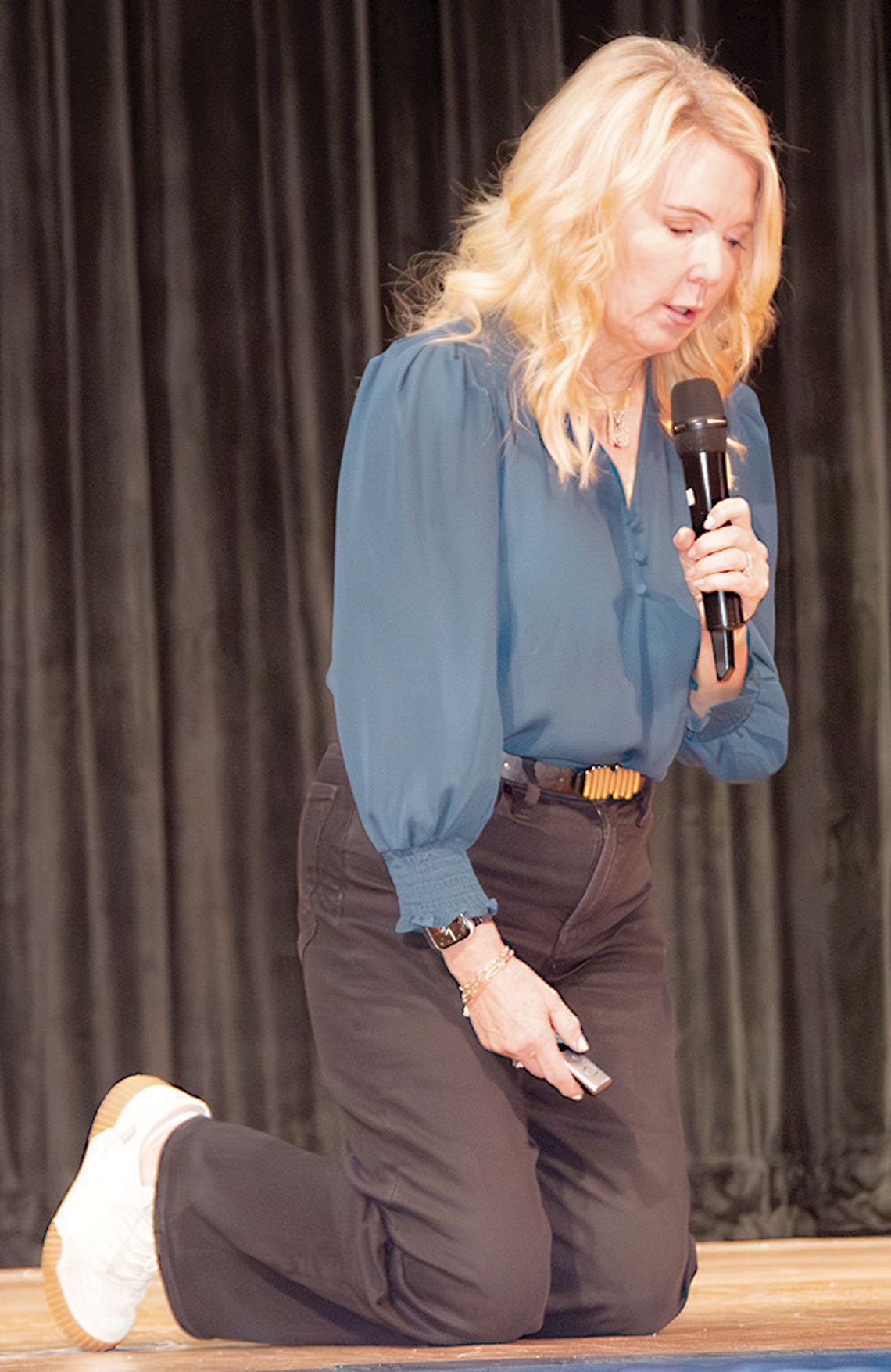
“I’ve gone out to towns that have been devastated by tornadoes where lives had been lost; I’ve covered all kinds of tragedies and accidents,” Kennecke told a full Tracy Area High School gymnasium Monday. “And when people did speak to me, they always told me the reason that they would talk to me was that they hoped that their story, their personal tragedy, would help someone else.”
• Emily’s death came just three days before she was scheduled to be checked into a treatment center, and her family was in the process of organizing an intervention to get her into treatment. Her loved ones were well aware of the life choices she had been making after she got in with the wrong people. They knew she was abusing drugs like marijuana, but had no idea she was a heroin user. Kennecke said she tried everything to get her daughter back on the right path after she started experimenting with drugs her junior year of high school “For a while, I played bad cop; I did all the tough-love stuff that we are told we’re supposed to do,” she said. “I grounded her, I took away her phone … it didn’t seem to really stop her from smoking marijuana or trying Xanax.”
Part of the uphill climb the devoted mother was facing is the ease of which Emily was able to get her hands on pot or pills.
Unaware she was consuming fentanyl, the dose Emily used on that fateful day in May 2018 contained enough of the powerful opiod to kill six people.
Fentanyl is now found in everything from heroin and cocaine to fake prescription pills like Xanax and Adderall. In one study, the FDA found 60% of counterfeit pills that have fentanyl in them contain a lethal dose. It is said to be the number one killer of people between the ages of 18-45.
“All the science is showing us now how we can damage the developing brain,” said Kennecke. “It sets kids up for addiction. You’re 15% more likely to suffer from substance abuse disorder if you smoke marijuana at a young age.”
AfterEmily’sdeath,Kennecke started Emily’s Hope to focus on prevention, education, and reducing stigma surrounding substance use disorder. She also travels the country, speaking with vulnerability and honesty about her daughter and opioid addiction as a way to warn youth about the hazards of using drugs, especially at an early age.
• Kennecke, a member of the South Dakota Hall of Fame, speaks glowingly of her daughter, like any proud mother would — how she was a star student, talented artist and state-qualifying gymnast before drugs entered into her life. She even received a Scholastic Art Scholarship to the University of South Dakota. A quote from Emily that Kennecke carries with her everywhere is,” I hope to brighten the world through my passion for art.”
The Emily’s Hope Substance Use Prevention Curriculum, in school throughout the country, has been designed to address growing concerns surrounding substance use and overdose. The curriculum focuses on age-appropriate and evidence-based content that educates children about the risks of substance use while empowering them to make healthy choices. By fostering open communication between children, parents, and educators, it aims to create a supportive environment that promotes well-being and resilience.
Kennecke’s appearance was sponsored by the Tracy Area Education Foundation; the audience included adults, as well as students from both Tracy Area High School and Westbrook-Walnut Grove High School.
“Angela could have stepped out of the spotlight, instead she decided to speak up,” TAHS Principal Mandy Dibble said in introducing Kennecke Monday. “She believes that when tragedy strikes, the only thing you can control is how you respond. She’s choosing to respond by fighting the shame that keeps people from asking for help, because addiction is a disease that deserves understanding.”
Autumn and her handyman husband Walker went to work, taking on projects one at a time to get their rambler ready. Outside of that, Autumn kept very busy as a nanny for three girls and a daycare worker in Balaton, Head Start in Tracy and in Westbrook. She was pregnant during her stop in Westbrook and begrudgingly had to leave there.
“It was chaos — I was pregnant, trying to do the director role,” she recalls. “It was so much, plus the drive. One of the families asked if I would be willing to nanny after maternity leave.”
The nannying stopped when those kids started school, and Autumn’s kids went back into daycare, which she knew was going to be expensive.
“I decided it was time to bite the bullet and start my own daycare!” she said.
Being surrounded by littles is something Christians relishes. Her four children — Caysen (6), Grace (5), Waylon (2) and Wrenleigh (1) — do their part in keeping Autumn and her husband Walker plenty busy, but she is ready for even more chaos.
Christians is in the process of attaining her daycare license that will allow for up to 10 kids under her care. And she knows from experience how important it is for small towns to be able to offer such services.
“I feel like having more daycare offered is bringing more younger families back to the area,” she said. “Families are moving to bigger towns that have a couple centers and inhome daycares. We can bring more families here and have the younger families here if there are these opportunities.”
Two of Christians’ kids are now school-aged, which will allow her to take on the added responsibilities that come with an influx of little feet. That extra time, as well as her passion for children, sets her up for success.
“I’m excited, I’m ready,” she said. “When I was at the daycare in Westbrook, we had 14 toddlers and two to three adults in the classroom — we were outnumbered all the time. This has been my dynamic forever; there’s always been kids around.”
Autumn, who has earned her