The City of Tracy wasted little time in cashing in on a recently-awarded $25,000 Minnesota Department of Natural Resources grant that paid for an arborist to conduct an assessment of trees on public land.
A tree assessment that took place in Tracy last week showed Tracy is home to 1,298 trees on public land, including boulevards — 423 of them, or 33%, are ash trees.
Carpenter estimates that it would cost about $105,000 a year to treat the trees.
The $25,000 paid for counting of the trees ($19,000) and the final report ($3,000). The City will now take another step in its fight against Emerald Ash Borer by applying for a larger grant.
“This will help us apply for the big grant, which will help us decide what to do with (the ash trees),” City Administrator Jeff Carpenter said. “Everybody is going after these grants.”
Other area cities dealing with severe EAB issues include Lake Benton, Marshall and Lamberton. Marshall ($92,860) and Pipestone ($38,500) were also awarded grant monies from the $7 million ReLeaf Grant pot. In all, 50 Minnesota communities received grant monies to help manage for a healthy, resilient canopy in the face of emerald ash borer and other forest health concerns. Recipients included 34 cities, five county organizations, four schools, six nonprofits, and the Leech Lake Band of Ojibwe.
The invasive emerald ash borer is a small, iridescent green beetle, roughly one-half inch long, that attacks ash trees.
In the adult stage, it nibbles on ash foliage but does not destroy the tree. In its immature larvae stage however, the insect tunnels through and eats an ash tree’s inner bark, preventing the tree from transporting water and nutrients, ultimately killing the tree.
Funded by the Minnesota State Legislature, the ReLeaf program will support tree inventories, plantings, maintenance, pruning, management plans, outreach and wood utilization projects. Projects can occur on public land or low-income residential properties.
Many of the projects funded will focus on replacing lost ash trees with a variety of species to help protect against pests and diseases.
Other projects include removing hazard trees and using that wood for outdoor learning and play spaces. Another project provides scholarships for those pursuing the International Society of Arboriculture Certified Arborist exam.
“You don’t have to travel several hours north to enjoy fall colors. Some of the most beautiful views are right on our own streets and in neighborhood parks,” Madisson Masucci, DNR urban and community forestry coordinator, said in a news release. “These ReLeaf grants help communities manage and plant a variety of trees so their canopies are resilient and healthy for future generations to enjoy.”
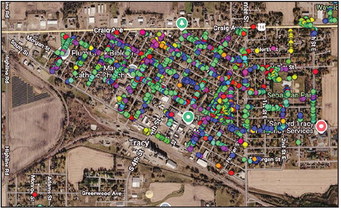
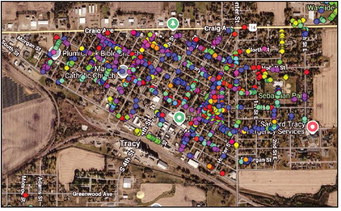
THE DOTS ON THESE AERIAL IMAGES OF TRACY depict trees in town. The difference between the two is the ash tree population, which are is represented by the hundreds of green dots on the image at left. Aspen Arboriculture Solutions, LLC images